Tuesday, December 10, 2013

Veteran celebrates new homecoming

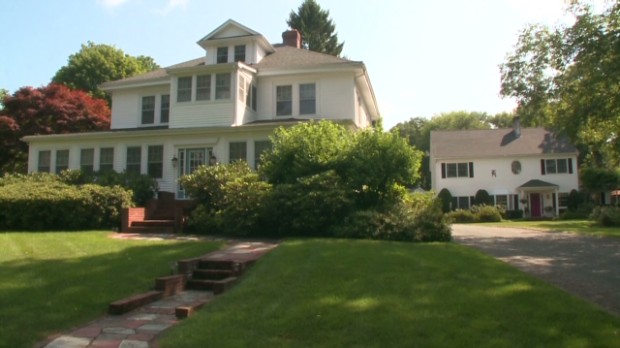
U.S. Army Cpl. Christopher Sullivan celebrated a second homecoming on December 4 with his family courtesy of Operation Finally Home.

Cpl. Sullivan and his family were presented the keys to their new home in League City at a welcoming home event hosted by Operation Finally Home in partnership with Harbour Classic Builders, Texas Home Improvement with Jim Dutton, Reliant Energy, the Houston Texans Matt Patrick, NewsRadio 740 and members of the League City community.

"We just want to thank Chris for your service, and we hope you like your new home," said Murphy Yates, president of Harbour Classic Builders on Wednesday.

In 2011, Sullivan returned home to California, recovering from injuries suffered during a suicide bombing in Afghanistan. During his homecoming party, he was shot trying to break up a fight between a family member and a guest and was paralyzed from the neck down.

Operation FINALLY HOME is a non-profit organization that honors wounded and disabled vets and widows of fallen soldiers with mortgage-free, new custom-built homes.

"Chris has sacrificed so much during his years of service," said Rusty Carroll, vice president of Operation Finally Home. "Operation Finally Home continues to be thankful for sponsors like Harbour Classic Builders, the Houston Texans and THI because they allow us to fulfill our mission in thanking these veterans and the widows of the fallen in the best way we know how, by providing them with mortgage-free homes."

The mission of Operation Finally Home, established in 2005, is to provide wounded and disabled vets and their families' mortgage-free homes to contribute in their efforts to rebuild their lives.

"Seeing Chris' expression as he arrived at his new home was a moment none of us will soon forget," said Yates. "The League City community has truly embraced this build, and we are honored to have been a part of this project."

Sullivan first learned about plans for his new home at a Houston Texans game in December 2012 as a surprise.

"The Houston Texans are so grateful to our service members, veterans and their families for their sacrifices," said Jamey Rootes, president of the Houston Texans. "We are honored to partner with Operation FINALLY HOME to support our wounded community. Providing Chris with a new home is a way for all of us to say thank you for what he has done to protect our nation and our freedom, and it will help him and his family get a fresh start."

To learn more, visit OperationFinallyHome.org[1].

Source : http://www.yourhoustonnews.com/bay_area/news/veteran-celebrates-new-homecoming/article_57181958-12be-5283-b309-1a4e9e185c79.html

Thursday, December 5, 2013

Jobs growth drives rates

NEW YORK (CNNMoney)

Mortgage rates jumped this week on stronger-than-expected economic reports, according to Freddie Mac's weekly survey.

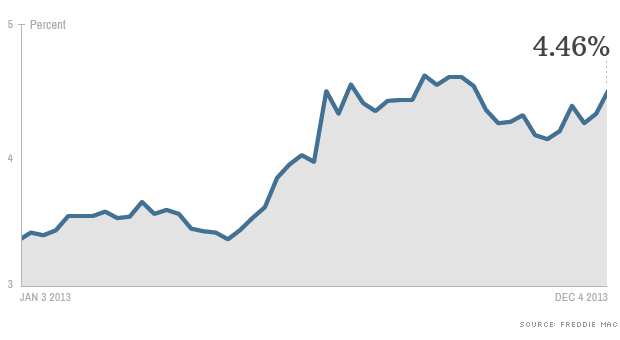
mortgage rates 12413The 30-year, fixed-rate loan, the most popular product for homebuyers, rose to 4.46% from 4.29% last week. The average rate on a 15-year, fixed-rate mortgage, typically used for refinancing higher interest mortgages, also jumped 0.17 percentage point to 3.47%.
This week's rate approached a high for the year. Rates on the 30-year have ranged from a low of 3.34% in the first week of January to a high
Source : http://rss.cnn.com/~r/rss/money_realestate/~3/enqLEtDl-_c/index.html

Jobs growth drives mortgage rates

NEW YORK (CNNMoney)

Mortgage rates jumped this week on stronger-than-expected economic reports, according to Freddie Mac's weekly survey.

mortgage rates 12413The 30-year, fixed-rate loan, the most popular product for homebuyers, rose to 4.46% from 4.29% last week. The average rate on a 15-year, fixed-rate mortgage, typically used for refinancing higher interest mortgages, also jumped 0.17 percentage point to 3.47%.
This week's rate approached a high for the year. Rates on the 30-year have ranged from a low of 3.34% in the first week of January to a high
Source : http://rss.cnn.com/~r/rss/money_realestate/~3/enqLEtDl-_c/index.html

Wednesday, December 4, 2013

Soaring new home sales: Not what they seem

It was the sharpest jump in more than three decades, but housing watchers are already poking holes in the new home sales numbers. After delays due to the government shutdown, data for both September and October were released together, in addition to a large downward revision for August. Follow the numbers, and the gains are not quite what the headline seems.

Contracts signed to buy newly built homes jumped 25.4 percent in October month to month, after falling 6.6 percent in September from August. The seasonally adjusted annual rate went from an originally reported 421,000 units in August, which was revised down to 379,000 units, and to 354,000 units in September. The number for September was a 10 percent drop from September of 2012. It then rose to 444,000 units in October. There is a nearly 20 percent margin of error on all these numbers.

"The October 'preliminary' report released this morning, along with the terrible August and September data, is the outlier and will be revised lower next month in line with the new trend lower that began in July," noted housing analyst Mark Hanson.

August sales estimates were revised down by 15 percent on an unadjusted basis and September sales dropped from there.

"Both the September and October new home sales data were released together and averaged 399,000 annualized versus the estimate of 424,000 and compares with the average year-to-date of 422,000," said Peter Boockvar, chief market analyst of economic advisory firm  The Lindsey Group. "The weakness seen in July through September was clearly in response to the rise in rates and the almost 25-basis-point decrease in mortgage rates in October seemed to have brought out buyers that were previously on the fence."
[3]

Builders say it wasn't just the falling rates, but the end of the government shutdown.

Source : http://www.cnbc.com/id/101246658

New Home Sales Surge in October as Supply Dwindles

Lucia Mutikani
WASHINGTON -- Sales of new U.S. single-family homes recorded their biggest increase in nearly 33½ years in October, suggesting the housing market recovery remains intact despite higher mortgage rates.
The Commerce Department said Wednesday[1] sales jumped 25.4 percent to a seasonally adjusted annual rate of 444,000 units. It also said new home sales fell 6.6 percent in September.
New Home SalesThe release of both the September and October reports was delayed because of a 16-day partial shutdown of the government[2] last month.
Economists polled by Reuters had expected new home sales to set a 428,000-unit pace last month.
Compared with October last year, new home sales were up 21.6 percent.
The strong rise in new home sales, which are measured when contracts are signed, suggested higher mortgage rate had not derailed the housing market recovery.
Higher mortgage rates[3] have slowed the pace of home sales, but demand for accommodation as household formation continues to recover from multidecade lows is keeping demand supported.
Home resales fell in October for a second straight month and confidence among single-family home builders has ebbed somewhat since nearing an eight-year high in August.
Strong new home sales in October saw the stock of houses on the market falling 3.7 percent after touching their highest level in nearly three years in September. Despite the tight supply of properties, the median price of a new home slipped 0.6 percent from a year-ago.
At October's sales pace it would take 4.9 months to clear the houses on the market, down from 6.4 months in September. A supply of 6.0 months is normally considered as a healthy balance between supply and demand.

New mortgage rules may mean less choice

(CNNMoney)

New rules launching early next year designed to make mortgages safer may result in less choice for borrowers.

The problem: small banks may drop out of the business because of the cost of tougher regulations.

Beginning Jan. 10, banks have to ensure that monthly mortgage payments are affordable, a result of the Dodd Frank law passed in 2010. The failure to do so carries strict penalties.

"My concern is that we're going to be in an environment where some lenders are too small to comply," said David Stevens, CEO of the Mortgage Bankers Association.

During the housing bubble, some banks issued loans without even checking applicants' income or assets.

Under the new rules, lenders must carefully determine that borrowers have the ability to repay their loans. That means, for example, that the banks can't lend to anyone whose total debt payments would exceed 43% of their income. Lenders must carefully examine and double check pay statements, bank records, tax returns and other paperwork provided by borrowers.

Banks will have to make three main changes, according to Anthony Hsieh, CEO of loanDepot, an online mortgage bank.

They will have to update their underwriting policies and procedures, change their technology and retrain staff.

Is there a housing bubble in California?

Already, lending had become more complicated.

Five years ago, Total Mortgage, a mid-sized lender in Connecticut, had a single attorney on retainer to handle compliance issues, according to its president John Walsh.

Today, Total Mortgage has three full-time workers who work exclusively on compliance in addition to the outside counsel, even though his business has not grown.

"I expended a lot of effort to stay ahead of the new regulations," Walsh said. "You just can't make mistakes these days."

Related: 10 Best Places to Retire[4]

Banks large and small are hiring outside companies to handle a share of their mortgage underwriting to ensure the quality, according to Jeff Taylor, co-founder of Digital Risk, a provider of risk, compliance and transaction management services.

Big banks can handle the cost, but small lenders may not be able to afford all the extra manpower.

The changes are coming at an already challenging time. Fewer homeowners have been refinancing their old, high interest mortgages. "Now that the refi boom is over, we'll see a lot of small banks fading away," said Taylor.

It's possible that bankers, never receptive to regulation, may be overstating the impact of the new rules, according to Ellen Schloemer, spokeswoman for the Center for Responsible Lending, a consumer advocacy group.

She points to an October report from CoreLogic that asserted that lenders should be able to meet the requirements. The report was written by Margarita Brose, a consultant on lender risks, and Faith Schwartz, who ran Hope Now, a coalition of lenders, consumer groups and government organizations that fights foreclosure.

Lenders will "figure out a way to deliver . . . mortgages in a way that meets all the regulatory requirements, incorporates sound lending and consumer protections -- and makes a profit," according to the report's authors.

Source : http://rss.cnn.com/~r/rss/money_realestate/~3/Zg2Uv1bAM6U/index.html

Mortgage Applications Slide for Fifth Straight Week

Luciana Lopez

NEW YORK -- Applications for U.S. home loans tumbled in the latest week, led by a sharp slide in refinancing applications, data from an industry group showed Wednesday.

The Mortgage Bankers Association said[1] its seasonally adjusted index of mortgage application activity, which includes both refinancing and home purchase demand, sank 12.8 percent in the week ended Nov. 29.

The week's results included an adjustment for the Thanksgiving holiday last Thursday, the group said.

The data marked the fifth straight weekly drop for the index, taking it to its lowest level since early September.

The fall in mortgage applications comes as investors try to gauge when the U.S. Federal Reserve[2] might exit its bond-buying program.

The Fed has said it would begin to scale back its $85 billion a month in purchases of Treasuries and mortgage-backed securities when policy makers are convinced of a steady, self-sustaining recovery.

But data on the world's biggest economy[3] have been mixed, leaving investors uncertain about the future path of U.S. monetary policy.

MBA data showed 30-year mortgage rates rose 3 basis points in the latest week to 4.51 percent.

The refinancing index sank 17.5 percent while the purchase index, a leading indicator of home sales, fell 4.1 percent.

The mortgage survey covers over 75 percent of U.S. retail residential mortgage applications, according to MBA.

Source : http://realestate.aol.com/blog/2013/12/04/mortgage-applications-slide-fifth-straight-week-mba/

Soaring new home sales: Not what they seem

It was the sharpest jump in more than three decades, but housing watchers are already poking holes in the new home sales numbers. After delays due to the government shutdown, data for both September and October were released together, in addition to a large downward revision for August. Follow the numbers, and the gains are not quite what the headline seems.

Contracts signed to buy newly built homes jumped 25.4 percent in October month to month, after falling 6.6 percent in September from August. The seasonally adjusted annual rate went from an originally reported 421,000 units in August, which was revised down to 379,000 units, and to 354,000 units in September. The number for September was a 10 percent drop from September of 2012. It then rose to 444,000 units in October. There is a nearly 20 percent margin of error on all these numbers.

"The October 'preliminary' report released this morning, along with the terrible August and September data, is the outlier and will be revised lower next month in line with the new trend lower that began in July," noted housing analyst Mark Hanson.

August sales estimates were revised down by 15 percent on an unadjusted basis and September sales dropped from there.

"Both the September and October new home sales data were released together and averaged 399,000 annualized versus the estimate of 424,000 and compares with the average year-to-date of 422,000," said Peter Boockvar, chief market analyst of economic advisory firm  The Lindsey Group. "The weakness seen in July through September was clearly in response to the rise in rates and the almost 25-basis-point decrease in mortgage rates in October seemed to have brought out buyers that were previously on the fence."
[3]

Builders say it wasn't just the falling rates, but the end of the government shutdown.

Source : http://www.cnbc.com/id/101246658

Monday, November 25, 2013

Highest property taxes in America

NEW YORK (CNNMoney)

If you don't want to grind your teeth at night over your property tax bill, steer clear of Manhattan's New York suburbs and those in northern New Jersey.

They're home to the three counties that charge the highest average property taxes in the country.
By contrast, a number of counties in Alabama and Louisiana have some of the lowest.
Those are among the findings of a new residential property tax study[1] from the Tax Policy Center, which analyzed data from the American Community Survey[2].
Across the United States as a whole, between 2007 and 2011, 60% of counties reported average property tax burdens of between $500 and $1,500 a year.
That might cover one month's tax burden for many homeowners in one of the three most expensive counties: Westchester County, N.Y. ($9,647 a year); Nassau County, N.Y., ($9,080) and Bergen County, N.J. ($8,893).
Another five counties in New Jersey had average annual burdens topping $8,000.
By contrast, of the 24 counties nationwide with annual property taxes below $250 a year, nearly all were in Alabama and Louisiana, the study found.
In some states, property taxes are modest in dollar terms, but rank high when the tax burden is measured as a share of home price[3].
Related: American dream homes: What you'll pay in 10 cities[4]
Parts of Michigan, Nebraska, North Dakota and Ohio fall into this category. Their property taxes on average well exceed 1% of home prices, whereas in most counties in the nation, the average property taxes fall below the 1% mark.
Property taxes are some of the most opaque for taxpayers to figure out.
Live big or small in the Best PlaceFor one thing, there's no single formula that every county and state uses to calculate them.
In addition, the "assessed" value of your home on which your property taxes are based can bear little resemblance to your home's market value.
And there's no telling from one year's assessment to another how high your bill will be. "[M]any localities set a revenue target[5] to meet expenditure needs and then vary the tax rate to meet this target, conditional on the tax base," the study said.
  [6]No wonder, then, when asked by Gallup[7] what they considered to be the least fair tax, the percent of Americans who chose the local property tax has nearly doubled, from 24% in 1988 to 42% in 2005.

Of course, counties with higher property taxes tend to spend more on things like education and public services. They may also have higher priced homes. Or they may be higher simply because the local government isn't bringing in other major sources of revenue[8], like an income tax.
"In general, localities in states with high property tax burdens tend to have little or no other local taxes," the Tax Policy Center study noted.
Source : http://rss.cnn.com/~r/rss/money_realestate/~3/jHO9dy3Jx3s/index.html

Thursday, November 21, 2013

Mortgage rates fall amid weak economic data

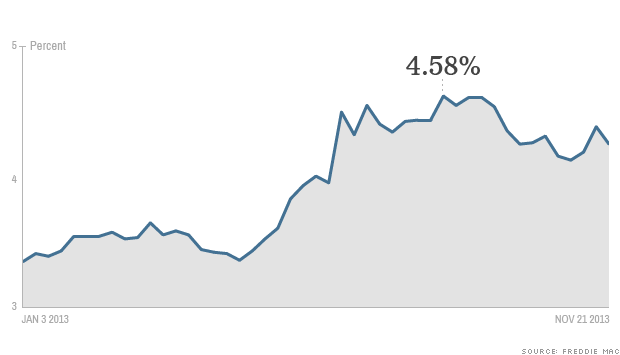
Average rates on 30-year fixed mortgages fell to 4.22% this week, down from a 2013 high of 4.58% in August.
NEW YORK (CNNMoney)

Mortgage rates fell significantly this week amid weaker-than-expected economic reports, according to a weekly survey by Freddie Mac.

30 year mortgage ratesThe average rate for a 30-year, fixed-rate loan, the most popular mortgage product, fell to 4.22% from 4.35% last week, Freddie Mac reported. Meanwhile, average rates on 15-year, fixed-rate loans, typically used for refinancing higher interest mortgages, dropped to 3.27% from 3.35% the week before.
This week's drop was one of the steepest during a year of mostly rising rates. The 30-year started 2013 at 3.34% and reached a high of 4.58% in August.
Related: American Dream homes: What you'll pay in 10 cities[1]
Frank Nothaft, Freddie's chief economist said fixed mortgage rates fell amid reports of weaker manufacturing growth, with industrial production declining by 0.1% in October, below expectations. He also cited declines in the overall inflation rate, noting that the consumer price index saw its "smallest increase since October 2009" last month.
Is there a housing bubble in California?  [2]
Is there a housing bubble in California?
Weighing on mortgage rates long-term is the Fed's stimulus program -- known as quantitative easing -- which entails that it buy $85 billion in bonds each month. The impending appointment of Janet Yellen as Fed chairman[3], who has defended the QE3 policy, has many believing the Fed's policy will remain in place.
Related: Five of the most (and least) affordable housing markets[4]
"Ms. Yellen would likely continue the QE policies started under Chairman Bernanke until there was very clear evidence that the economy would thrive, not just endure, without them," said Keith Gumbinger, a spokesman for HSH.com, a mortgage information company.
Find Homes for Sale…Check Out www.pearlandhomesforsale.biz.  Your Home Resource for Pearland and surrounding areas

Source : http://rss.cnn.com/~r/rss/money_realestate/~3/BsqpbQr8B0w/index.html

How a Real Estate Agent Who Knows VA Loans Can Save Vet Thousands


Shutterstock

Selecting a real estate agent is one of the most important choices you'll make when buying or selling a home. The decision becomes even more important when you're a veteran or active duty service member looking to use the VA mortgage guaranty. This nearly 70-year-old loan program backed a record 630,000 home loans in fiscal year 2013, nearly double the 2011 volume.

That's a huge increase in just two years' time. You typically only need a credit score[1] of 620 to qualify for a VA loan, which is more than 100 points lower than some other mortgage products. (It's important to check your credit before applying for any home loan, including VA loans. You can pay for a credit score or use a tool like the Credit Report Card[2], which gives you free credit scores and a breakdown of what's impacting your credit.)

As lending standards have become more stringent, greater numbers of veterans are using their VA loan eligibility as the only realistic path to homeownership. The VA loan is a specialized loan program only available to those who have served our country, and, because of this, it comes with some unique requirements. Veterans can really benefit from an agent[3] who can educate and guide them through the entire process.

Closing Costs: If you've done much research on purchasing a home or have purchased a home before, you know there are closing costs associated with the loan. "Closing costs"[4] is an umbrella term for the fees and costs charged by the lender and third parties who conduct work on your file throughout the process, such as a title company. They research the chain of title for the property and complete a significant amount of paperwork to assist in your home purchase. Working with a VA-knowledgeable agent can even save you thousands of dollars when it comes time to go under contract.

The VA has established a list of certain fees[5] that you, as the buyer, are not permitted to pay. This is good for you, because it means your overall cost is lower. But your agent needs to understand these non-allowable costs so they can try to ensure the seller covers them when drafting an offer. Agents should also know how to structure an offer and eventually a contract to deal with closing costs. Because the VA loan is 100 percent financing, meaning you don't have to put any money down, you're not generally able to roll your closing costs into the purchase amount. But that doesn't necessarily mean you're stuck paying them, since your agent can ask that the seller pay all closing costs.

Your second option is to decide how much you want to offer on the home, get an estimate of your closing costs and then add the two together. By making an offer combining the two amounts, you are effectively rolling the costs into the loan. Sellers are generally more accepting of this method because it doesn't change their bottom line.

It's important to note here that the home will have to appraise for the full contract amount. If it doesn't, you'll have to renegotiate to lower the price or walk away from the deal. Agents unfamiliar with this strategy could mean thousands of dollars paid out of pocket to cover these costs or completely restructuring the contract, adding additional time to the process.

Property Requirements: The VA also has a set of minimum property requirements (MPRs) to ensure the property is safe and structurally sound for a veteran homebuyer and their family. A few examples of common MPRs include peeling lead-based paint, exposed wires or lack of a handrail on stairs. These repairs generally have to occur before you can close on the home, and, if the seller refuses or the repair can't be done, you will likely have to walk away from the home.

Failing to satisfy the property requirements can absolutely kill your deal. Veterans can also run into trouble trying to purchase unique properties, like geodesic domes, berm homes, A-frames and other relatively uncommon structures. The home appraisal process[6] revolves around good recent comparable home sales, and it can be tough to find workable "comps" for unusual homes or properties with significant acreage. Appraisals can cost around $500, which is a lot to spend on a home that's never going to fly with the VA appraisal process. That's why agents who understand these requirements can save veterans time, money and heartache.

VA-savvy agents can steer you from problematic properties at the outset, and also help guide you to closing if there's a shot at making the deal work. The experience of a VA-knowledgeable real estate agent is invaluable when shopping for a home. Be sure to ask any agent you interview whether they've closed VA loans before, and, if so, how many. By working with an agent experienced in VA loans, you'll be on the right track to a smooth home purchase.

Source : http://realestate.aol.com/blog/2013/11/21/real-estate-agents-va-loans/

Wednesday, November 20, 2013

School finance lawsuit reopened; still on way to Supreme Court

When District Judge John Dietz ruled Texas' school finance system unconstitutional earlier this year, everyone expected the state to appeal.

And appeal it did. But along the way, the Legislature restored some of the money cut during the previous session, and made other changes to the state's education accountability system, leading Dietz to reopen the record and allow supplemental evidence about the new education bills.

"The Supreme Court needs to see that the new developments have been considered," said David Thompson of Thompson and Horton, and lead attorney representing one of the plaintiff groups. "I think it's the right thing to do."

Thompson gave an update to Spring Branch ISD trustees Monday, Nov. 11. Spring Branch is one of 84 districts in Thompson's Fort Bend ISD group that sued the state, claiming the school finance system is inadequate, inequitable, unfairly allocates funding to local districts and relies too heavily on property taxes in local districts.

The Fort Bend ISD group represents some 1.8 million schoolchildren, including Houston and Katy ISDs and most large suburban districts in the Houston area. The four groups bringing suits collectively represent some 630 school districts and 3.6 million schoolchildren, "the largest group of students ever" to join in a school finance lawsuit, Thompson said.

Dietz ruled in February that the state's school finance system was not equitable, not adequate, not suitable and creates a state property tax.

"It was probably the most sweeping decision in favor of schools in (Texas school finance) history," Thompson said.

Thompson said that while the 83rd Legislature this year restored $3.7 billion of the $5.4 billion cut by lawmakers in 2011, it didn't put it back in the same places where it was cut.

He said that the two sessions can't be looked at as disconnected but as "two halves of a whole."

"The combined effect of the two years was to level the system down, at the same time the state is raising its standards" said Thompson.

"Did the money put back this session help? Yes." Thompson said. "Is this a fundamental change of the system? No. It's a tweaking around the edges."

Public education in Texas is enshrined in the state constitution, in language that has remained unchanged since 1876. That language states that an educated populace is essential to a free society, and mandates the state "to establish and make suitable provision for the support and maintenance of an efficient system of public free schools."

Thompson said that "efficient" has been interpreted in earlier lawsuits to mean "equitable" and that equity doesn't have to be perfect but "roughly" equitable.

"Historically, (standards) have been pulled down, rather than up, and the courts have said 'no, equalize up to standards," he said.

He said that he didn't think the bills passed this year would change the case's outcome, and that the system is still unconstitutional. His goal is to get school finance "front and center" for the 84th Legislature in 2015.

Spring Branch ISD Superintendent Duncan Klussmann will give testimony through deposition as the case is reopened, representing the districts that are considered property wealthy but have significant populations of underpriveleged students.

Spring Branch ISD is a chapter 41 district, subject to the so-called 'Robin Hood' plan of school wealth equilization. And besides sending money to the state each year, as the district's cumulative appraised value rises, it gets less funding from the state as it collects more revenue locally. The district has advocated legislators for several years about returning control of local dollars back to districts.

Source : http://www.yourhoustonnews.com/sugar_land/news/school-finance-lawsuit-reopened-still-on-way-to-supreme-court/article_a425111e-520c-11e3-afab-0019bb2963f4.html

Because No One Plans to Be Homeless

Hi, Book Scan readers. I spent the first part of last week hanging out with community planners at the American Planning Association's national conference. Though I haven't read the book described below, I thought the author (who gave the closing keynote at the conference) had some beautiful thoughts on home ownership that real estate professionals would appreciate. Enjoy! —MW

Early Pearl has a great idea for dealing with an intractable problem. As a homeless 11-year old Chicagoan, she sees all of the sturdy housing stock that stands empty and abandoned in her south side neighborhood and decides to take action.

From the cover of Blue Balliett's new book, Hold Fast

She gets some friends together and, with a few cameras, they snap pictures of these empty houses. They send the pictures—along with their imaginings of how the structures could be transformed into dream homes for kids without anywhere to live—to community leaders in an effort to spark a change in their unfortunate circumstances.

Early is only a character in Blue Balliett's newest mystery novel, Hold Fast[1] (Scholastic Press, 2013). But there are more than 30,000 kids in Chicago alone who are homeless just like she is, and some 16,000 vacant properties like the ones that Early dreams of inhabiting.

"Kids will easily share their dreams about a home," Balliett said in her keynote speech at the American Planning Association's national conference last week. "They never make small plans."

Balliett, a bestselling author of young adult literature, told planners that she came up with the idea for Hold Fast during the housing downturn, when she noticed a dearth of news stories about the effect foreclosures were having on her target audience.

"The children were invisible," she said. "I kept wondering about the kids: Who are they and what does it feel like to grow up without a front door?"

Of course, community planners, writers, and nonprofit directors know as well as real estate professionals the value of home when it comes to children.

"What kids need most is stability in their lives and a home provides that… Blue's book really captured that," said Chicago Coalition for the Homeless Executive Director Ed Shurna, who spoke on a panel alongside Balliett at the closing keynote of the APA conference. "The danger is that they are going to stay homeless as adults."

W. Paul Farmer, executive director and CEO of the APA, called on members to devote more of their attention to this difficult problem.

"As we have become arguably the best-housed nation in the world… we have allowed ourselves to not realize that we have these problems," Farmer said. "These are, in fact, invisible to many people in the country."

In a brief Q&A period, attendees asked panelists what they could do to help solve the issue in their local communities.

"Part of the key is to make your community care and take ownership in this problem," Balliett responded. "Become determined to do something."

Meg White[2]

Meg White is the multimedia web producer for REALTOR® Magazine and administrator of the magazine's Weekly Book Scan blog.


DePelchin's Children's Center Holiday Project in Need


The holidays are fast approaching! We invite you to make a dream come true for a child this year by participating in the annual DePelchin Children's Center Holiday Project.

This annual effort provides gifts and basic needs to the children and families utilizing DePelchin Children's Center services. During this time, local businesses, organizations and individuals sponsor children by fulfilling wish lists, hosting toy drives, donating needed items, making monetary contributions or volunteering to sort and pack gifts. With the support of the community, we are able to brighten the holidays for over a thousand children each season! 

Here are four ways you can make a dream come true for DePelchin's children: 

Sponsor a Child

     Click here to view and select wish lists

Make a Cash Donation

Click here to make a cash donation

Host a Toy Drive

Click here for more information.

Volunteer Your Time

Click here to learn more.


For more information, please contact our Holiday Project coordinator at 713-802-7724 or email holidayproject@depelchin.org.